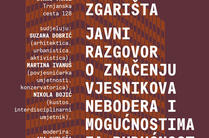
VJESNIK: REVISTING THE FIRE SITE / a public discussion on the meaning of the VJESNIK building and future possibilities
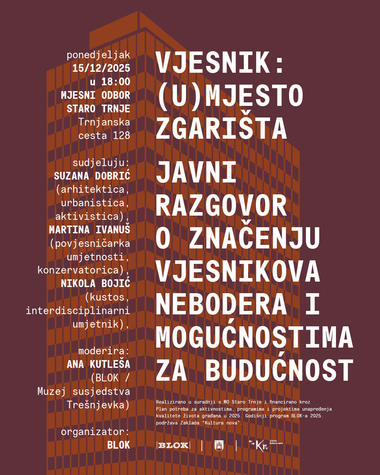
Monday, December 15, 2025, 6 p.m.
Staro Trnje Local Committee, Trnjanska cesta 128
Participants: Suzana Dobrić (architect, urbanist, activist), Martina Ivanuš (art historian, conservator), Nikola Bojić (curator, interdisciplinary artist)
Moderator: Ana Kutleša
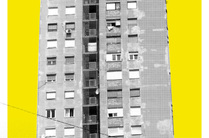
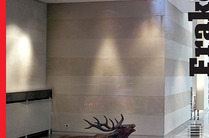
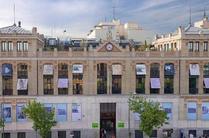
Vjesnik has become news – breaking news (at least for a brief moment), destroyed in a human-caused fire in the night of November 18. The City of Zagreb was deprived of one of its architectural landmarks, which had marked the city horizon for more than fifty years. But the very content of Vjesnik – the media machinery for the purposes of which it was built and for which it is warmly remembered by numerous journalists – had been shut down years before the fire broke out. Being silenced and extinguished for decades, media production slowly gave space to national archives and emptiness, which inevitably meant collapse. A single radio station, operational until the fire, reminded us of its former function, and on its margins a new life began to emerge over the past few years, through Bureau of contemporary art praxis Kontejner, Architecture studio Skroz, and collective Radiona. Despite being located in ground floor spaces, which did not catch fire, their future is uncertain, since the burnt structure is soon to be removed, and the whole complex is awaiting new life.
We will meet at the heart of the very neighborhood Vjesnik belongs to, to open the question on its legacy and whether it has been lost with the fire. What did this complex represent for those who saw it every day and walked in its shadow? What does it represent for architects and urbanists, and has it become, by ending so tragically, a symbol of general lack of care for modernist heritage? What could its future look like? Besides private capital interest and the huge market potential of the site, is there space for public interest, citizens’ participation, and life of the heritage? Having read and listened to numerous opinions in the media over the past days, we invite residents of Trnje, citizens of Zagreb, neighbors, journalists, architects and urbanists, activists and citizens, in short, all those who are interested in listening to three different perspectives that will try to answer these questions, to come and contribute to the discussion.
Suzana Dobrić is an architect and urbanist, and a member of the Physical Planning Committee of the Zagreb City Assembly. She was a vice-president of the Local Committee Trnjanska Savica, and she actively participated in numerous activist initiatives, such as Savica for the Park, and Bring the Magnolia Back campaigns, as well as in the campaign against the Zagreb GUP (General Urban Plan) amendments in 2019. She is active as an author and editor of articles in the field of physical planning activism.
Martina Ivanuš is an art historian, the author of the book Plitvice lakes – A century of Construction (UPI-2M, 2021), based on her doctoral dissertation on the architectural heritage of that region. She works at the Croatian Conservation Institute as a consultant conservator for education, professional development, and international cooperation. She is currently on the position of the vice-president of the Docomomo Croatia association, the national branch of the international organization Docomomo International, dedicated to documenting and preserving architectural modernist heritage.
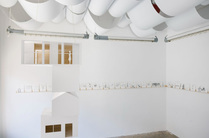
Nikola Bojić is a curator and artist who explores relations between space, technology, and the future. He obtained his Ph.D. on the topic of physical planning in Croatia 1955 – 1975, in the context of Lefebre's theory of space production. He currently works as an Assistant Professor in the Academy of Fine Arts in Zagreb. In 2024, he put on, together with Damir Prizmić, Mijo Gladović, and Damir Gamulin, the exhibition Three Falls, which explored the Zagreb earthquake, the fall of the drone, and the slow disintegration of Vjesnik through in-depth research and use of various technologies. The project was produced by the Bureau Kontejner, and the piece was exhibited in its space on the ground floor of the Vjesnik building.
Organized by: BLOK
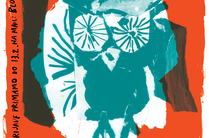
Design by: Nikola Križanac
Carried out in cooperation with the Local Committee Staro Trnje and financed through the Plan of Needs for Activities, Programs, and Projects of Improving the Life Quality of Citizens in 2025. BLOK's annual program for 2026 is supported by the “Kultura nova” Foundation.